
The Gulf of Mexico is one of the most significant bodies of water in the Western Hemisphere, with a complex mix of physical features, marine ecosystems, and oceanographic dynamics. Using a Gulf of Mexico Map provides not only a visual guide to its geography but also insight into the interactions of currents, coastlines, and underwater formations that make this region unique.
Geographical Overview
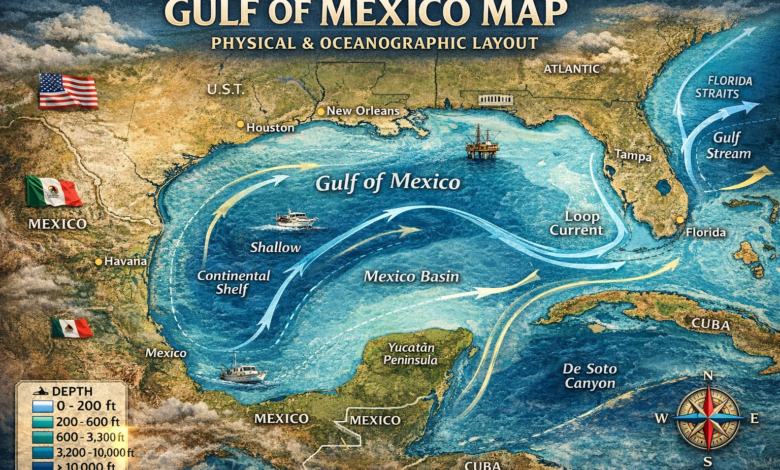
The United States borders the Gulf of Mexico to the north, Mexico to the west and south, and Cuba to the southeast. A Gulf of Mexico map highlights its roughly 615,000 square miles of surface area and its connection to the Atlantic Ocean via the Florida Straits and the Caribbean Sea via the Yucatán Channel.
Key geographical features visible on a Gulf of Mexico map include:
-
Coastlines: From the sandy beaches of Florida and Texas to Mexico’s Yucatán Peninsula.
-
Major Rivers: The Mississippi River, which drains a large portion of North America into the Gulf, creating fertile delta regions.
-
Offshore Features: Submerged continental shelves, banks, and underwater ridges that are critical for marine life and energy exploration.
Oceanographic Features
The Gulf of Mexico is not just a static body of water; it’s a dynamic oceanographic system. A Gulf of Mexico map can help visualize these processes:
-
Currents and Circulation
-
The Loop Current flows from the Caribbean Sea into the Gulf, then exits through the Florida Straits, influencing temperature, salinity, and marine biodiversity.
-
Smaller coastal currents shape sediment transport along the northern and western shores.
-
-
Bathymetry
-
The gulf’s depth ranges from shallow continental shelves near the coasts to deep basins exceeding 14,000 feet.
-
A detailed Gulf of Mexico map often shows the deep Mexico Basin, Sigsbee Deep, and other underwater features critical for navigation and scientific research.
-
-
Temperature and Salinity Zones
-
The northern gulf is heavily influenced by freshwater inflows like the Mississippi River, creating variable salinity zones.
-
Temperature gradients affect seasonal hurricane formation and fisheries productivity.
-
Economic and Ecological Significance
A Gulf of Mexico map also illustrates regions of high ecological and economic importance:
-
Oil and Gas Reserves: The Gulf contains vast offshore oil fields, with platforms scattered throughout the deepwater regions.
-
Fisheries: Shrimp, snapper, and other commercially important species rely on estuaries and continental shelves visible on maps.
-
Coastal Habitats: Mangroves, marshes, and barrier islands provide storm protection and habitat for wildlife.
Maps also help monitor areas prone to environmental risks, such as oil spills or hurricane impact zones.
Navigational and Scientific Applications
The Gulf of Mexico map is essential for navigation, research, and disaster management. Mariners use detailed bathymetric maps for safe passage, while oceanographers and climatologists track currents, storm patterns, and ecological changes. Modern digital maps even integrate satellite data, allowing scientists to monitor real-time oceanographic conditions.
Conclusion
A Gulf of Mexico map is more than just a geographic reference; it’s a window into the gulf’s complex physical structure, oceanographic processes, and ecological significance. From continental shelves to deep basins, from currents to coastal habitats, understanding this layout is critical for navigation, resource management, environmental protection, and scientific study.
Exploring a Gulf of Mexico map allows students, researchers, and enthusiasts to appreciate the interplay between geography, oceanography, and human activity in one of the world’s most vital marine regions.