
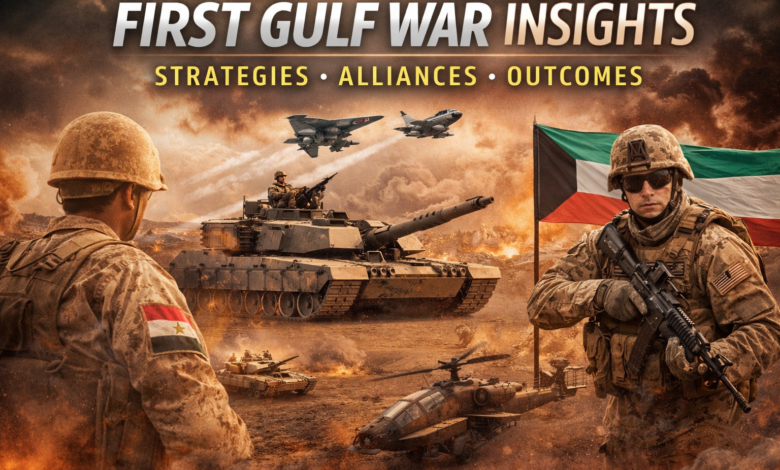
The first gulf war (1990–1991), often referred to as Operation Desert Storm, marked one of the most significant military and diplomatic conflicts of the late 20th century. Sparked by Iraq’s aggressive invasion of Kuwait, this conflict reshaped Middle Eastern geopolitics, tested modern military strategy, and highlighted the power of coordinated international alliances.
Roots of the Conflict: Iraq’s Invasion of Kuwait
On 2 August 1990, Iraqi forces under President Saddam Hussein launched a large‑scale invasion of neighboring Kuwait, deploying elite divisions and armored units to quickly overrun the country. Baghdad accused Kuwait of overproducing oil and harming Iraq’s economy — complaints that masked deeper territorial ambitions and financial pressures following the prolonged Iran‑Iraq War.
The international community, led by the United Nations, swiftly condemned the invasion. Security Council resolutions demanded Iraq’s immediate withdrawal and authorized economic sanctions to pressure its leadership. When diplomacy failed, global powers prepared a military response to enforce Kuwait’s sovereignty.
Coalition Strategy: From Desert Shield to Desert Storm
Operation Desert Shield
The first phase of the conflict was defensive. Under Operation Desert Shield, a U.S.-led coalition of over 30 nations positioned forces in Saudi Arabia to deter further Iraqi moves and protect key oil infrastructure. This strategic buildup served both as a deterrent and as preparation for offensive action, illustrating the importance of forward positioning in modern conflict.
Operation Desert Storm
Diplomatic efforts failing, the coalition launched Operation Desert Storm on 17 January 1991 with a devastating air campaign. Coalition aircraft targeted Iraqi command centers, air defenses, and communication networks, achieving air superiority within days. Strategic bombing weakened the Iraqi military’s ability to resist and opened the way for a ground offensive.
In late February, the coalition’s rapid ground assault — sometimes called the “100‑Hour War” — advanced swiftly through Kuwait and southern Iraq. Iraqi forces, already degraded by months of air attacks, collapsed under coordinated mechanized assaults, leading to the liberation of Kuwait and a ceasefire on 28 February 1991
Alliances That Shaped the Campaign
One of the most notable aspects of the first Gulf War was the breadth and diversity of its coalition. Beyond the dominant roles played by the United States and United Kingdom, forces from Saudi Arabia, Egypt, France, and many other nations contributed personnel, equipment, and strategic support.
The alliance underlined several key themes:
-
Multinational Commitment: Countries spanning NATO allies and Arab states worked together — a rare alignment of interests bridging cultural and geopolitical divides.
-
UN Legitimacy: United Nations Security Council resolutions provided legal backing for intervention, reinforcing the coalition’s actions as enforcing international law rather than unilateral aggression.
-
Regional Security Priorities: Gulf states, especially Saudi Arabia and Kuwait, were central to coalition planning, emphasizing the war’s strategic importance for energy markets and regional stability.
This network of alliances demonstrated how diplomatic alignment can amplify military strength, creating a force far more formidable than any single nation’s capability.
Strategic Milestones and Battlefield Lessons
The first gulf war showcased several pivotal military strategies:
Air Dominance First
The coalition’s decision to prioritize air supremacy redefined modern warfare. By systematically dismantling Iraqi air defenses and command infrastructure before ground operations began, coalition forces minimized their own casualties and shattered Iraqi morale.
Rapid Mechanized Ground Assaults
Once air power had softened defenses, coalition ground forces executed swift armored thrusts that broke Iraqi lines across southern Kuwait. The efficiency of these maneuvers highlighted the power of integrated force structures combining mobility, firepower, and logistics.
Combined Arms Coordination
The campaign set precedents in joint operations, uniting air, land, and naval components from different countries into a cohesive, synchronized effort — a model that influenced military planning worldwide.
Outcomes and Lasting Consequences
The first gulf war ended in a clear tactical victory for the coalition: Kuwait was liberated, Iraqi troops were expelled, and major damage was inflicted on Baghdad’s military capabilities. However, the strategic outcomes were nuanced:
-
Saddam Hussein Remained in Power: Despite defeat, Iraq’s leadership survived, leading to prolonged economic sanctions and future conflicts in the region.
-
Strengthened U.S. Presence: The war expanded U.S. military influence in the Gulf, with bases and agreements that would shape Middle Eastern geopolitics for decades.
-
Environmental and Human Costs: Beyond battlefield losses, the conflict triggered environmental damage — including massive oil well fires — and long‑term health issues for soldiers and civilians alike.
Legacy of the First Gulf War
Today, the first gulf war is remembered not just for its rapid military campaign, but for its demonstration of coalition warfare, the impact of precision technology, and the limits of force when not coupled with lasting political solutions. It reshaped military doctrine globally and continues to influence how international coalitions respond to regional aggression.